Global Sports Circuits: Unpacking Travel Logistics and Athlete Recovery Across Tennis, Football, and American Leagues
Written by Parker Vogel · Aug 26, 2026
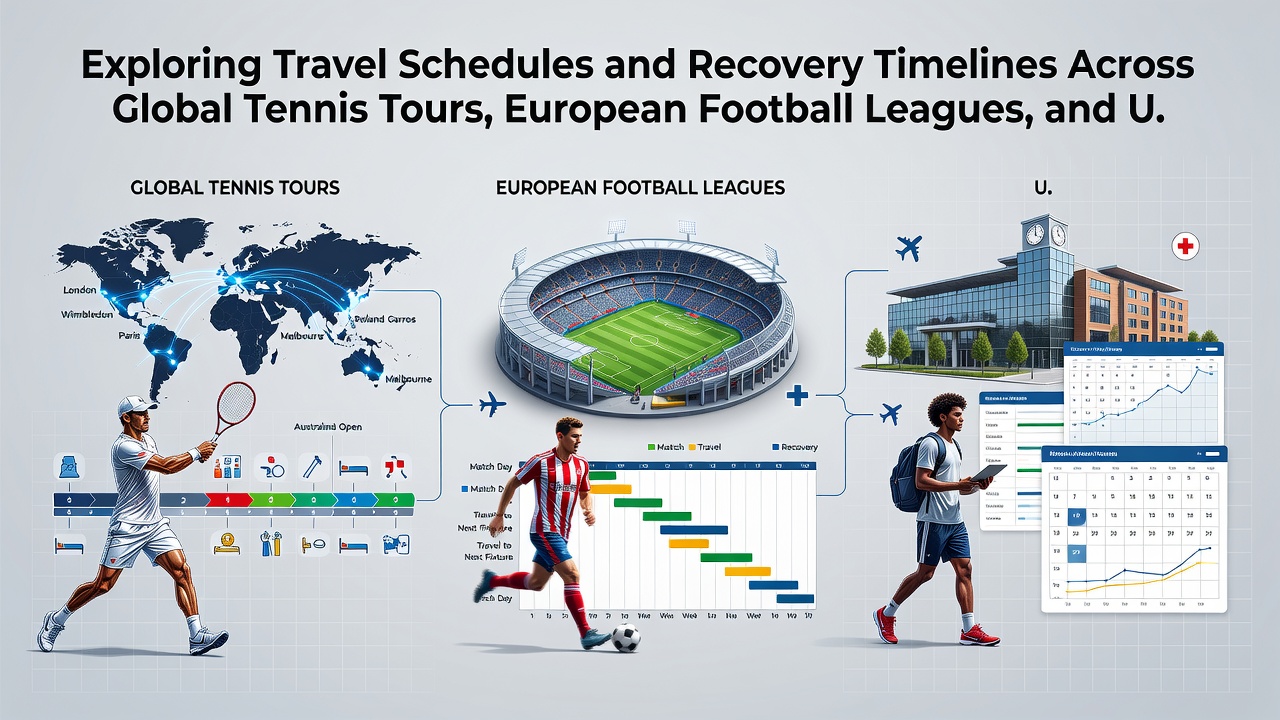
Global Sports Circuits: Unpacking Travel Logistics and Athlete Recovery Across Tennis, Football, and American Leagues
Professional athletes across tennis, European football, and major American leagues face demanding calendars that combine frequent flights with limited rest windows, and researchers have documented how these patterns affect performance metrics over entire seasons. Data from governing bodies shows that top tennis players often cover more than 100,000 kilometers annually while shifting between time zones as distant as Melbourne and Paris within a single month, whereas European football clubs balance domestic fixtures with midweek Champions League trips that span the continent in under 48 hours.
Tennis Tour Demands and Jet Lag Effects
Global tennis schedules pack multiple events into tight windows, and the ATP calendar places the Australian Open in January followed immediately by hard-court swings across North America and Europe, forcing players to adjust circadian rhythms repeatedly. Studies conducted by sports medicine groups indicate that eastward travel disrupts sleep architecture more severely than westward journeys, with recovery periods extending up to five days for full physical restoration after crossing eight or more time zones. Observers note that players who reach semifinals at one tournament frequently arrive at the next venue with only two full nights of sleep before their opening matches, and figures from the International Tennis Federation reveal elevated injury rates during these compressed transitions.
European Football Travel Patterns
Clubs in the Premier League, La Liga, and Bundesliga manage dense fixture lists that include weekend league games plus Tuesday and Wednesday European matches, and UEFA tracking data shows average flight distances per team exceeding 15,000 kilometers during a typical group stage campaign. Teams based in northern England or Scandinavia routinely fly to southern venues such as Seville or Athens, landing late at night before returning for domestic obligations, while recovery protocols emphasize immediate sleep interventions and light training sessions the following morning. Research published in the Journal of Sports Sciences highlights that fixture congestion correlates with measurable drops in high-intensity running distance during the second half of matches, particularly when teams cross multiple time zones within a seven-day span.
August 2026 will see the US Open overlap with the opening weeks of several European domestic seasons, creating additional pressure on players who compete in both tennis slams and national team windows during the same calendar month.

American League Schedules and Cross-Country Logistics
NBA and NFL franchises navigate the largest geographic spreads, with teams traveling from Boston to Los Angeles or Miami to Seattle in a single day, and league records indicate that some clubs accumulate over 50,000 kilometers during a regular season. The NBA schedule features occasional back-to-back games in different cities, yet data compiled by the league's sports science staff shows that teams allocate specific recovery days featuring cryotherapy, nutrition timing, and monitored sleep to mitigate fatigue accumulation. NFL teams experience fewer regular-season games but contend with longer recovery demands after Thursday night contests that require cross-country returns before Sunday, and studies from American universities have quantified how these patterns influence next-game output statistics.
Recovery Timelines Across Disciplines
Evidence gathered by the American College of Sports Medicine demonstrates that athletes require between 24 and 72 hours to restore baseline neuromuscular function after transcontinental flights, though individual responses vary based on age, fitness level, and prior acclimatization. European football medical teams often implement structured protocols that include melatonin timing and light exposure management, while tennis support staff focus on adjusted training loads during the first 48 hours post-arrival. Observers have recorded that consistent application of these methods reduces reported muscle soreness and maintains serve speeds or sprint velocities closer to baseline levels throughout congested periods.
Integrated Calendar Pressures in 2026
With the US Open scheduled for late August 2026 and major European leagues resuming shortly after international breaks, athletes who participate across multiple codes encounter overlapping demands that compress rest intervals further. Coordination between national federations and tournament organizers has produced minor adjustments to start times and travel windows, yet the core challenge remains the physical toll of repeated long-haul journeys within short succession. Figures released by sports analytics platforms indicate that players and teams who maintain detailed recovery logs achieve more stable performance outputs during the autumn stretch of each season.
Conclusion
Travel schedules in global tennis, European football, and American leagues continue to test the limits of human recovery capacity, and ongoing research tracks how structured interventions influence long-term athlete availability. Organizations ranging from the International Olympic Committee to regional leagues compile data that informs future calendar adjustments, allowing participants to balance competitive requirements with physiological needs across an increasingly interconnected sports landscape.