Weather Dynamics Shaping Endurance in Global Tennis Circuits and European Soccer Leagues
Written by Parker Butler · Aug 2, 2026
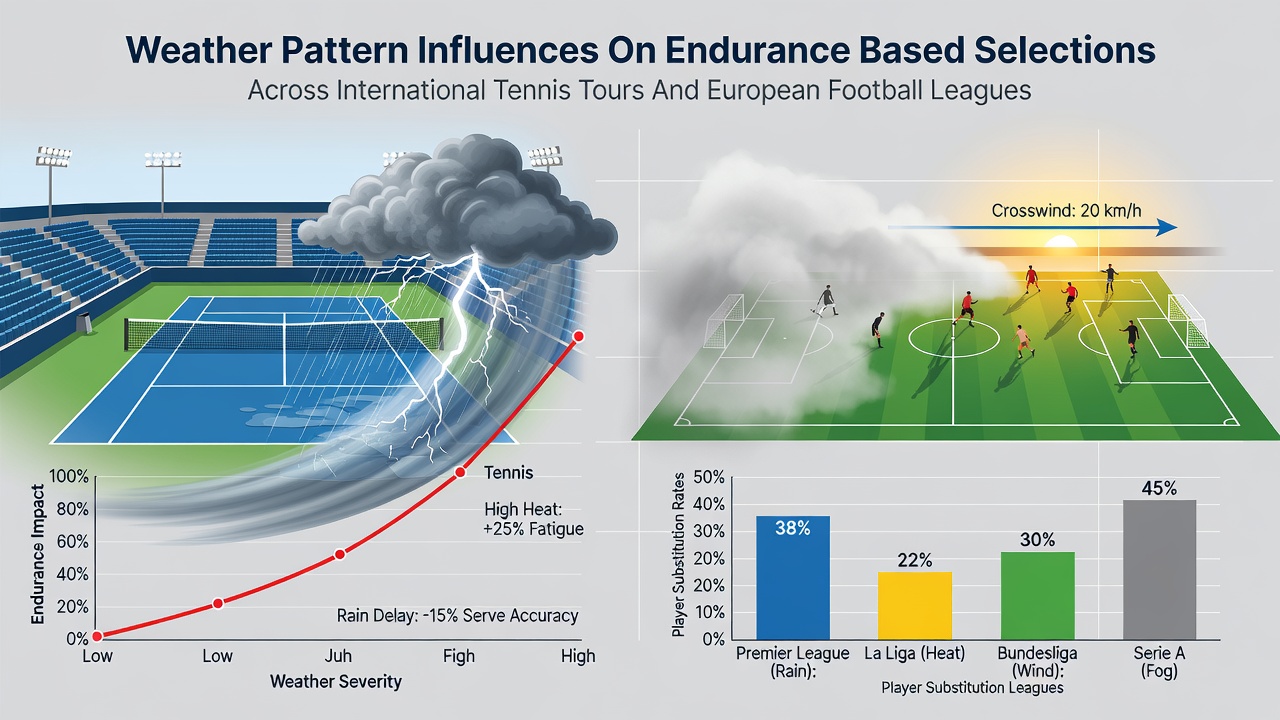
Weather Dynamics Shaping Endurance in Global Tennis Circuits and European Soccer Leagues
Weather patterns exert measurable effects on player endurance across international tennis tours and European football leagues, influencing selection decisions made by coaches and analysts who track atmospheric variables such as temperature, humidity, wind speed, and precipitation. Data collected from major events in 2025 and early 2026 show that elevated heat indices correlate with reduced rally lengths and increased recovery intervals, prompting adjustments in lineup choices that prioritize athletes with documented heat acclimation profiles.
Atmospheric Variables in Tennis Tournaments
International tennis circuits schedule matches across diverse climates, and studies from the World Meteorological Organization indicate that prolonged exposure to temperatures above 30 degrees Celsius combined with relative humidity exceeding 60 percent accelerates dehydration rates in competitors during best-of-five set encounters. Observers note that players selected for late-August events like the US Open often undergo pre-tournament testing for cardiovascular endurance under simulated conditions, while those with lower thresholds receive reduced playing time or strategic rest periods. Wind patterns further complicate court conditions, as gusts exceeding 25 kilometers per hour alter ball trajectory and force competitors to expend additional energy on directional adjustments, a factor documented in match statistics from the Australian Open and Wimbledon where such conditions recur seasonally.
Effects on European Football League Preparations
European football leagues commence their campaigns in August when residual summer heat and occasional thunderstorms intersect with fixture congestion, leading teams to modify squad selections based on endurance metrics gathered from GPS tracking systems. Research conducted by the European Institute of Sports Science demonstrates that high humidity levels during evening fixtures in leagues such as the Bundesliga and Serie A increase core body temperatures among midfielders, resulting in measurable declines in high-intensity running distances after the 60-minute mark. Coaches therefore favor substitutes who maintain sprint output under these loads, particularly when forecasts predict dew-point temperatures that limit evaporative cooling on natural grass surfaces.
Comparative Analysis Across Both Sports
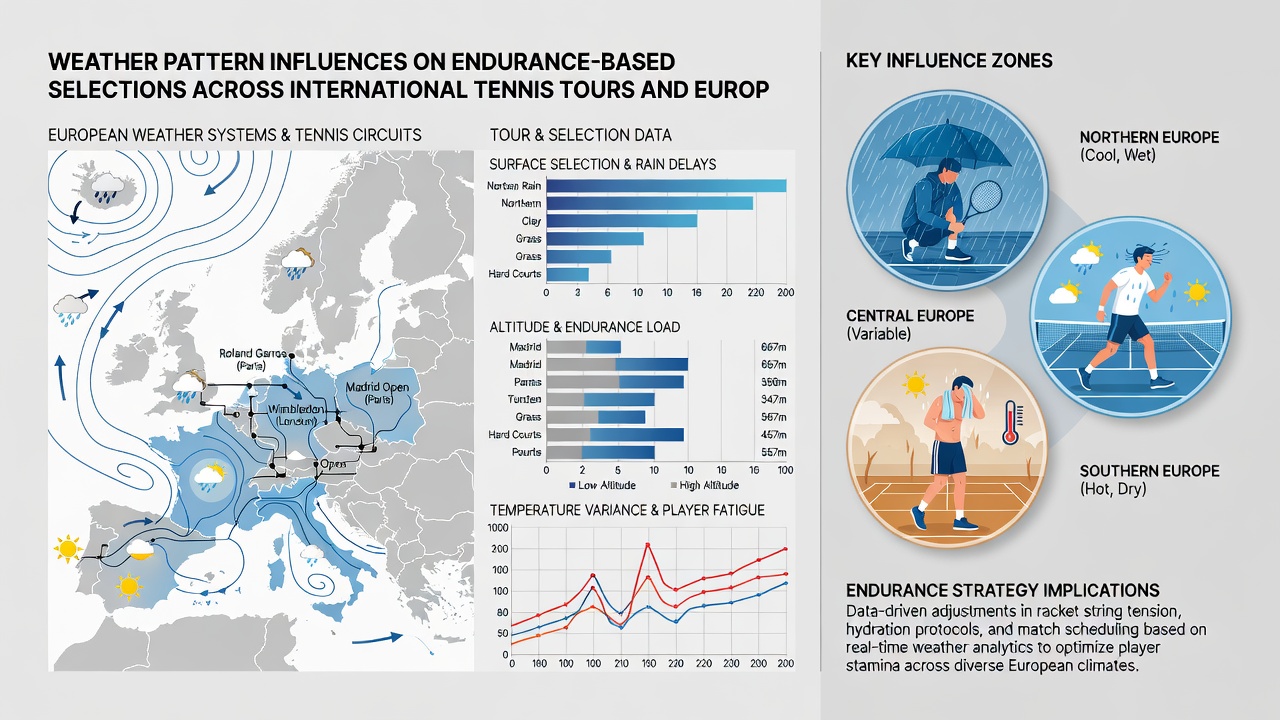
Both tennis tours and football leagues rely on similar physiological benchmarks when weather influences endurance thresholds, yet the structural differences in match duration create distinct selection pressures. Tennis matches can extend beyond three hours in fluctuating conditions, whereas football halves last 45 minutes each, allowing managers to rotate personnel more frequently when forecasts indicate incoming fronts that bring cooler air and altered ground friction. Figures from the 2026 pre-season across Serie A and La Liga reveal that teams monitoring soil moisture content adjust training loads accordingly, because saturated pitches demand greater muscular effort during acceleration phases and increase injury risk for players lacking specific conditioning.
Analysts cross-reference meteorological data with historical performance records to refine selections, noting that consistent high-pressure systems often stabilize playing surfaces in southern European venues while low-pressure zones introduce variable winds that affect long-ball strategies in northern leagues. Those who study these intersections observe that endurance-based choices become more pronounced during double-header weeks in August, when recovery windows shrink under sustained warmth.
Data Sources and Measurement Approaches
Academic institutions across multiple continents contribute datasets that link weather variables to performance outputs, with one collaborative project between Canadian and Australian universities providing longitudinal records on heat stress indices for outdoor endurance sports. These records demonstrate that athletes who train in controlled humidity chambers exhibit improved lactate threshold maintenance when competing in comparable tournament environments. Selection committees integrate such findings with real-time forecasts to determine which competitors or squad members align best with projected conditions, thereby optimizing collective output without exceeding physiological limits.
Conclusion
Weather pattern influences on endurance selections continue to shape decision frameworks in both international tennis and European football, supported by ongoing data collection from regulatory bodies and research networks that track atmospheric and physiological interactions. As schedules progress through 2026, the integration of refined forecasting tools with performance analytics remains central to how teams and tours manage athlete deployment under variable environmental loads.